

Product Introduction
A sludge conditioning system prepares polymer (PAM) solution and doses it into sludge so that fine particles flocculate and release water before dewatering. Dosing accuracy affects polymer consumption and final cake dryness, so the dosing unit is as important as the press behind it.
Qingben Environmental Technology (Jiangsu) Co., Ltd. is a manufacturer and supplier of sludge and wastewater treatment equipment in Yangzhou, China. Our conditioning range has two dosing devices: the automatic integrated dosing device (QBYTH series, 500 to 4,000 L/h) and the manual dosing device (QBJY series, models 1000, 2000 and 3000).
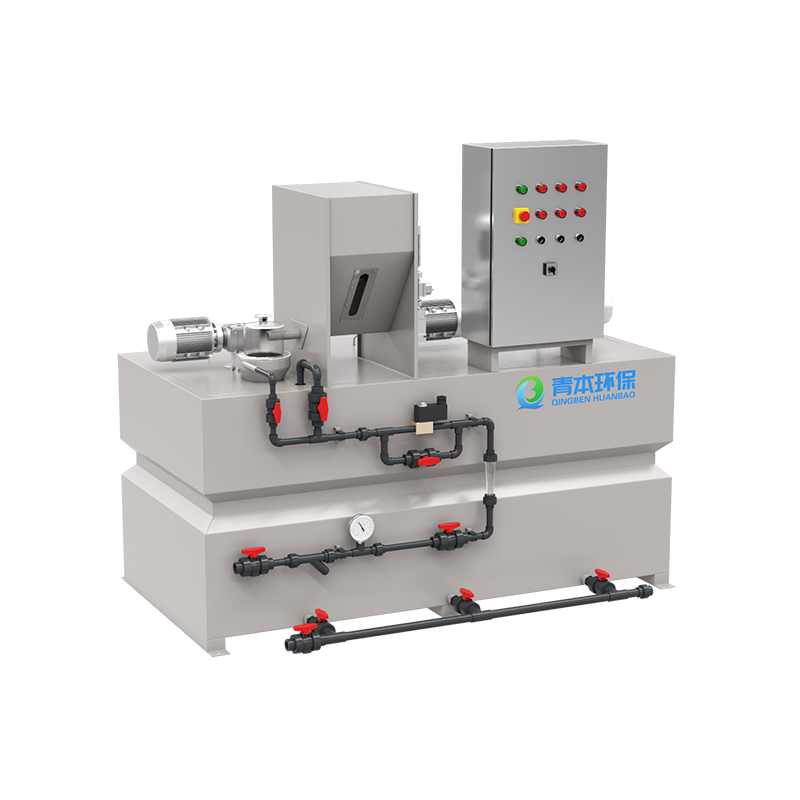
The integrated dosing device combines dry powder feeding, dissolution, maturation, metering and dosing on one skid. Maturation time is one hour, and a low powder level triggers an alarm. The manual unit integrates barrel, dosing pump, electric control box and pipe fittings on one frame, with a transparent level area for checking chemical use.
Both units can be wired into the control logic of our screw presses, belt presses and dryers before dispatch. Tank material, vacuum loader and online dilution options are available. MOQ, lead time, OEM/ODM and samples: please contact us for details.
Product Type
Automatic integrated dosing device and manual dosing device.
Core Models
QBYTH-500 to QBYTH-4000; QBJY1000, QBJY2000, QBJY3000.
Capacity
QBYTH: 500 to 4,000 L/h.
PAM Dry Powder Dosage
QBYTH: 1 to 20 kg/h depending on model.
Maturation
One hour on the integrated unit.
Tank Material
QBYTH: SS304, PP or FRP. QBJY: SS304, SS316L, PE or FRP.
Mixing Power (QBJY)
0.75 to 1.5 kW.
Options
Vacuum loader and online dilution system on the integrated unit.
Control
Fully automatic on QBYTH; manual refill on QBJY.
MOQ and Lead Time
Please contact us for details.
Specifications & Customization
QBYTH Integrated Dosing Device
| Model | Capacity (L/h) | Power (kW) | PAM Dry Powder (kg/h) | Water Intake (m3/h) | Net Weight (kg) |
| QBYTH-500 | 500 | 1.7 | 1 to 5 | 0.3 to 1.5 | 250 |
| QBYTH-1000 | 1000 | 2.45 | 2 to 10 | 0.6 to 3 | 400 |
| QBYTH-1500 | 1500 | 2.45 | 3 to 15 | 0.9 to 4 | 490 |
| QBYTH-2000 | 2000 | 2.45 | 3.5 to 20 | 1.2 to 6 | 550 |
| QBYTH-2500 | 2500 | 3.5 | 3.5 to 20 | 1.6 to 8 | 650 |
| QBYTH-3000 | 3000 | 3.9 | 3.5 to 20 | 2.0 to 10 | 700 |
| QBYTH-4000 | 4000 | 3.9 | 3.5 to 20 | 2.4 to 12 | 770 |
QBJY Manual Dosing Device
| Item | Details |
| Models | QBJY1000, QBJY2000, QBJY3000 |
| Mixing Power | 0.75 to 1.5 kW |
| Tank Material | SS304, SS316L, PE or FRP |
| Ports | Dosing DN25, water DN25, evacuation DN32 or DN40 depending on model |
| Structure | Barrel, dosing pump, electric control box and fittings on one frame |
Specifications are as published on the product pages. Confirm model details before ordering.
Customization Options
Tank MaterialSS304, PP or FRP on QBYTH; SS304, SS316L, PE or FRP on QBJY.
Vacuum LoaderOptional on the integrated unit.
Online DilutionOptional on the integrated unit.
Control InterfaceLinked to the dewatering line logic.
Voltage and FrequencyConfigured for the destination country.
OEM/ODM and BrandingPlease contact us for details.
Applications & Target Customers
Application Scenarios
| Industry / Application | Typical Use | Relevant Product Features |
| Municipal sludge dewatering | Polymer dosing ahead of screw or belt presses | Automatic dosing; adjustable concentration |
| Industrial wastewater | Flocculation of chemical or biological sludge | Tank material options for chemical resistance |
| Small or intermittent plants | Occasional dosing with staff present | Compact manual unit |
| Sludge drying lines | Conditioning of feed before dewatering and drying | Linked control logic |
| Wastewater flocculation | PAM preparation for settling or flotation | Adjustable liquid concentration |
Target Customers
Plant Operators
Need steady polymer preparation with less manual work.
EPC Contractors
Need dosing units with defined capacity and tank options.
Industrial Users
Need material choices for their chemical.
Distributors
Need a two-product dosing range for resale.
Suitable and Unsuitable Uses
Suitable Uses
Continuous or unattended dosing rooms (QBYTH)
Plants wanting adjustable liquid concentration
Small or intermittent dosing points (QBJY)
Lines with a screw press, belt press or dryer
Unsuitable Uses or Applications Requiring Additional Evaluation
Plants using no polymer: dosing equipment is not needed
Very high dosing duty beyond the published range: please contact us
Non-PAM chemicals: confirm compatibility first
Unattended operation with a manual unit
Selection Guidance
Application Requirements: Chemical, concentration and mode.
Technical Specifications: PAM kg/h and L/h.
Working Environment: Room size, water and drainage.
Material Compatibility: Tank and wetted part materials.
Installation Conditions: Power, water and piping.
Budget and Order Quantity: Please contact us for details.
Usage Notes
- Product inspection: Check model and nameplate.
- Installation: Connect water, dosing and drain ports.
- Operating environment: Check power and water supply.
- Powder storage: Keep dry powder dry to avoid caking.
- Daily check: Review powder level, tank and dosing line.
- Storage: Please contact us for storage requirements.
Advantages
Full Automation
The QBYTH integrates powder feeding, dissolving, maturation, metering and dosing.
Verifiable basis: Published QBYTH description.
Buyer benefit: Less manual work and steadier dosing.
Anti-Caking Design
Dry dosing and heating design reduce caking of powder.
Verifiable basis: Published QBYTH description.
Buyer benefit: Fewer feed interruptions.
Wide Capacity Range
Seven QBYTH models cover 500 to 4,000 L/h.
Verifiable basis: Model table on product page.
Buyer benefit: Size close to actual duty.
Low-Level Alarm
A low powder level triggers an alarm signal.
Verifiable basis: Published QBYTH description.
Buyer benefit: Operators are warned before dosing stops.
Compact Manual Option
The QBJY integrates barrel, pump, control box and fittings on one frame.
Verifiable basis: Published QBJY description.
Buyer benefit: Simpler installation and transport.
Linked Controls
Both units can be wired into the dewatering line control logic.
Verifiable basis: Published supporting equipment description.
Buyer benefit: Simpler commissioning.
Frequently Asked Questions
- Q: What is the difference between QBYTH and QBJY?
- A: The QBYTH is a fully automatic dosing device with powder feeding, dissolving and maturation. The QBJY is a compact manual dosing device for low or intermittent dosing.
- Q: What capacity does the QBYTH cover?
- A: 500 to 4,000 L/h across seven models, with PAM dry powder dosage of 1 to 20 kg/h depending on model.
- Q: How long is the maturation time?
- A: The published maturation time of the integrated unit is one hour.
- Q: What tank materials are available?
- A: QBYTH: stainless steel 304, PP or FRP. QBJY: SS304, SS316L, PE or FRP.
- Q: Can the dosing unit link to my press?
- A: Yes. It can be wired into the dewatering line control logic before dispatch.
- Q: Are a vacuum loader and online dilution available?
- A: Both are listed as options for the integrated dosing device.
- Q: Do you offer custom or OEM/ODM supply?
- A: Please contact us for details.
- Q: What are MOQ, sample policy and lead time?
- A: These depend on model and configuration. Please contact us.
Contact Us to Learn More
Send us your sludge type, flow, polymer use and operating mode. Our team can recommend an integrated or manual dosing device and quote it with your dewatering line.
Dosing capacity, tank material, options, MOQ, delivery and technical support.
View More ProductsSend an Inquiry