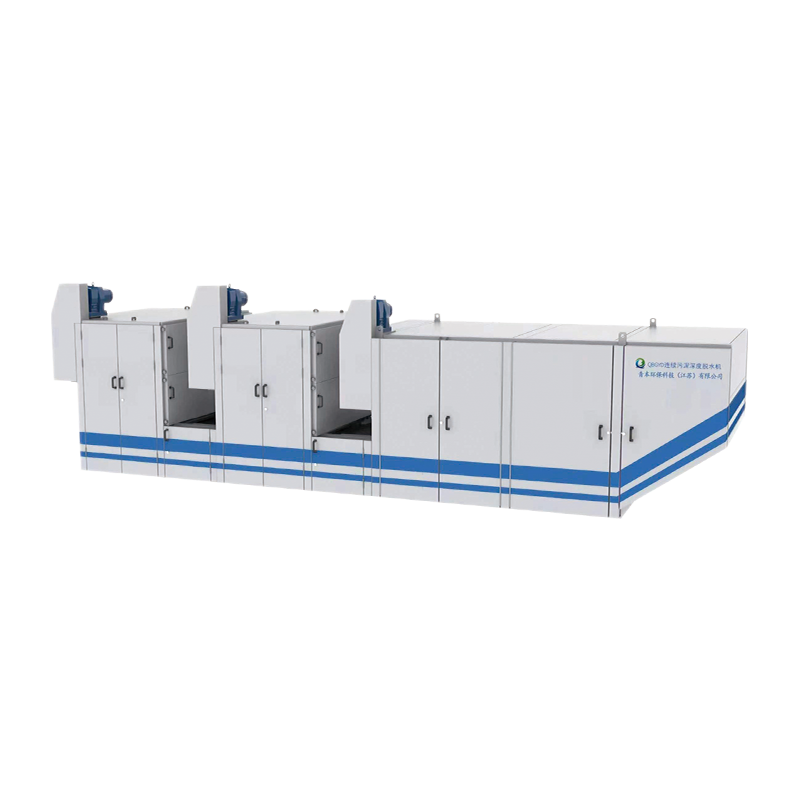


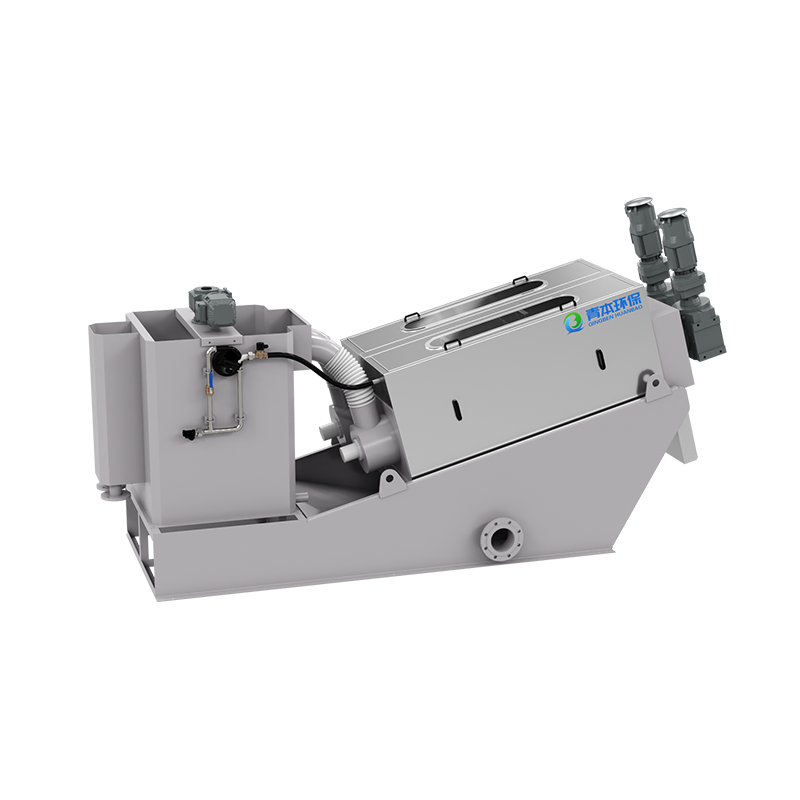
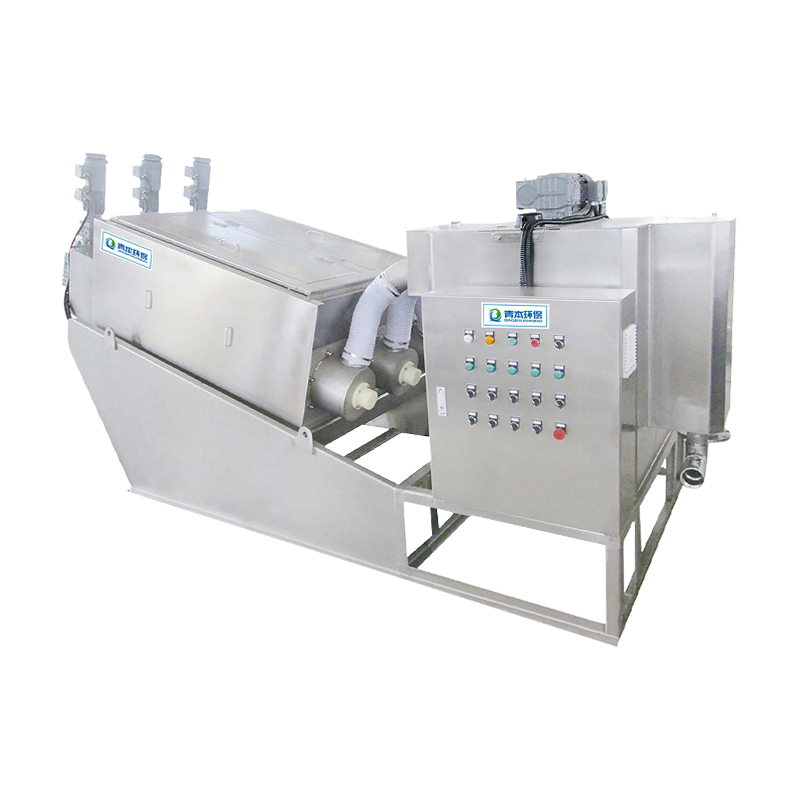
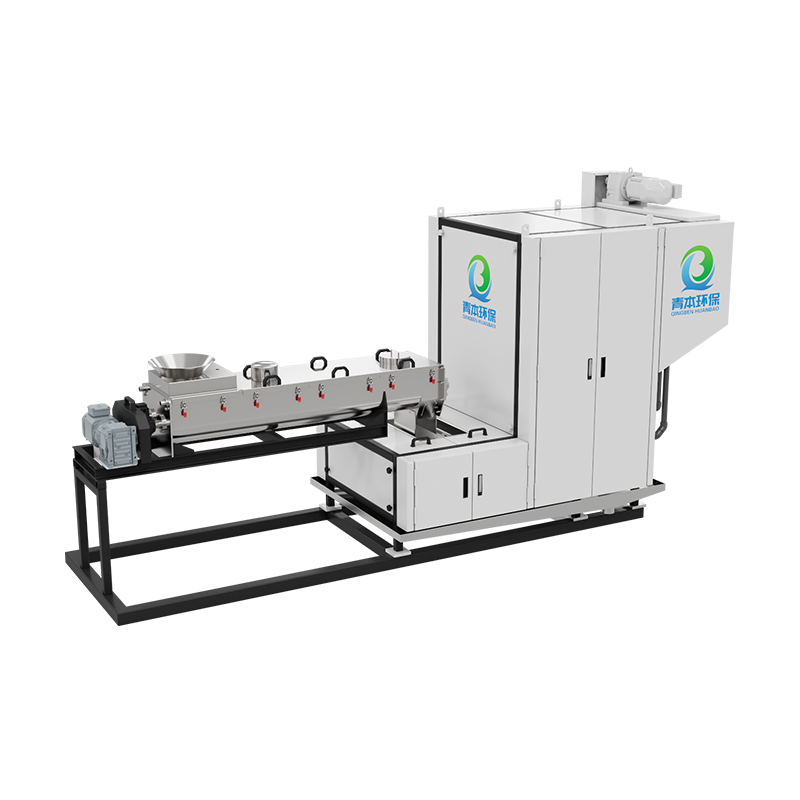
A plant that dewaters to 80% moisture still moves four tonnes of water for every tonne of dry solids. The haulier bills it as sludge, the incinerator charges by weight, and none of that water ever needed to leave the site. That single number — the water you have not removed — is why an energy saving sludge dryer often pays back faster than any other item in the sludge line.
The conclusion first: the lowest connected load on a datasheet is not the lowest running cost. A dryer running on 85–90 °C water you already have, or on heat recovered from its own exhaust, will normally beat a machine with a smaller nameplate but a steam demand attached to it. The rest of this page explains how to compare those options honestly, and where the losses actually hide.
Content
- 1 Where the energy actually goes in a sludge dryer
- 2 Why low temperature usually wins on running cost
- 3 The mass balance sets the size, not the brochure
- 4 Three configurations, and who each one suits
- 5 What a low-temperature line looks like in practice
- 6 Setpoints and checks that protect the savings
- 7 What to put in the purchase specification
- 8 Frequently asked questions
- 8.1 How much energy does a sludge dryer use per tonne of water removed?
- 8.2 What is the difference between a low-temperature sludge drying machine and a conventional hot-air dryer?
- 8.3 Can a sludge dryer run on waste heat instead of steam?
- 8.4 What moisture content should dried sludge reach for incineration or landfill?
- 8.5 How is the payback on an energy saving sludge dryer calculated?
- 8.6 Does low-temperature drying change the sludge dewatering step before it?
Where the energy actually goes in a sludge dryer
Evaporating water is physics, not marketing. At 100 °C, water absorbs roughly 2,260 kJ per kilogram to change phase, and a well-built dryer still needs about 1.2 to 1.8 times that once air heating, wall losses and residual moisture in the exhaust are counted. At 80% feed moisture, every tonne of dry solids means about four tonnes of water to evaporate, so the theoretical floor sits near 9 GJ per tonne of solids before a single inefficiency is added.
The difference between a good machine and a poor one lies almost entirely in what happens to the heat that never reaches the water. High-temperature rotary and fluidised-bed dryers heat large air volumes to 300–500 °C and discharge them at 90–120 °C; the exhaust carries a serious share of the purchased energy straight out of the stack. Low-temperature dryers keep most of the air in a closed loop and condense the moisture out instead of flushing it to atmosphere, which is exactly where the savings appear.
Why low temperature usually wins on running cost
In a heat-pump dryer, air at 40–80 °C passes over the wet cake, picks up moisture, then meets a cold evaporator coil where the water condenses out. The condenser returns the latent heat straight back into the process air. Typical coefficients of performance for that loop land between 2.5 and 4, which translates to roughly 0.25–0.4 kWh of electricity per kilogram of water evaporated, with no steam connection at all.
If the site already sends 85–90 °C water to a cooling tower — engine jacket water, compressor cooling, or digester heating return — a belt dryer can use it directly and only fans and drives draw power. That is the configuration where the gap against a steam-heated unit becomes widest, and it is common at municipal wastewater treatment plants and at food and beverage factories running chillers all year.
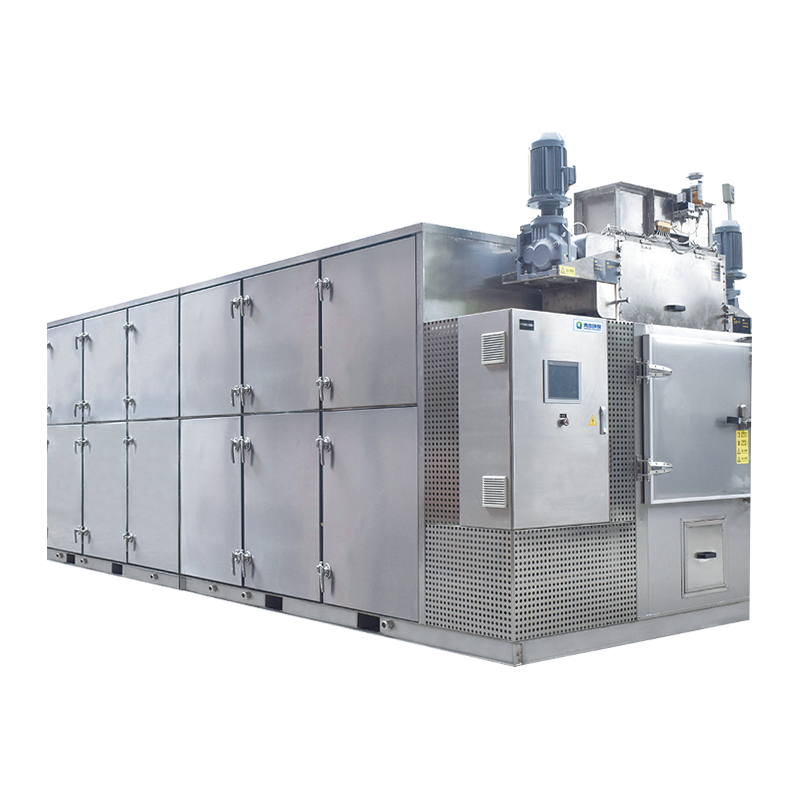 Low-Temperature Heat-Pump Belt Sludge Drying MachineFully enclosed belt dryer using heat-pump dehumidification at 48–56°C return air, with modular models from 750 to 32,400 kg/24h for sludge reduction.View Product →
The secondary savings are quieter but real: no boiler, no pressure-vessel inspection, no 400 °C surface to lag, and a product leaving at 40–60 °C rather than near 100 °C, so there is less dust and fewer volatilised odour compounds to handle downstream.
The mass balance sets the size, not the brochure
Dryers are sold in kilograms of water evaporated per hour, yet buyers often compare “tonnes of cake per hour”, which means nothing without a stated inlet and outlet moisture. Two machines rated at 500 kg/h of cake handle wildly different duties if one is quoted from 85% to 60% and the other from 80% to 20%. Convert to water removal first, every time.
| Final moisture | Wet cake mass (t) | Water removed (t) | Bulk reduction vs feed |
|---|---|---|---|
| 80% (dewatered only) | 50.0 | 0.0 | — |
| 60% | 25.0 | 25.0 | 50% |
| 40% | 16.7 | 33.3 | 67% |
| 30% | 14.3 | 35.7 | 71% |
| 10% | 11.1 | 38.9 | 78% |
Read the table with the last stretch in mind: going from 80% to 30% removes 35.7 t of water per 10 t of dry solids, while pushing on to 10% removes only 3.2 t more. That final 3.2 t is the most expensive water in the whole process, because it costs residence time, belt area and building height. Many plants sensibly stop at 30–40% moisture and burn or co-compost the result.
Three configurations, and who each one suits
Low-temperature belt dryer with an integrated heat pump
This is the default choice for plants without a cheap heat source. Modular belts, two to four temperature zones and a sealed air loop mean the unit can sit indoors without a stack, and the condensate can be returned to the head of the works. The trade-off is that all the heat comes from electricity, so the value of the machine depends heavily on your tariff and on how much of the load you can shift to cheap hours.
Low-Temperature Waste-Heat Sludge Drying MachineModular low-temperature dryer for sites with recovered hot water, offering 10,000–50,000 kg/24h standard water removal and PLC control.View Product →
Low-temperature dryer driven by waste heat
When 85–90 °C water is already being cooled in a heat exchanger, using it to dry sludge turns a disposal problem into a free heat sink. Electricity consumption drops to fans, drives and controls — often an order of magnitude below a heat-pump unit — and the dryer becomes a useful trim cooler for the plant. Check the seasonal availability of that water before you size the belt; a summer-only source should be backed up or the throughput accepted as seasonal.
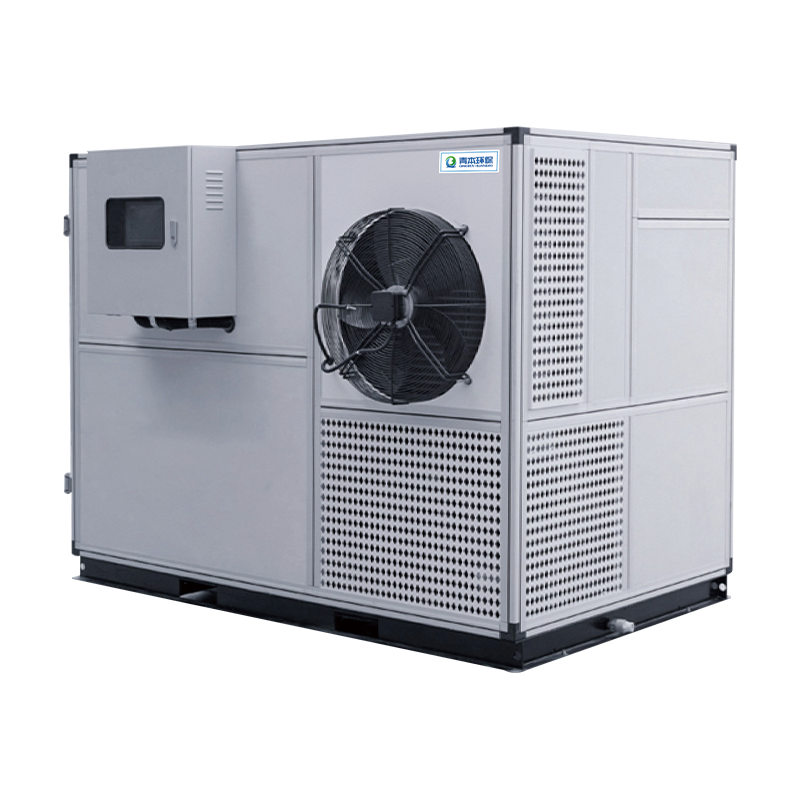 Low-Temperature Chamber Sludge Drying MachinePackage-type chamber dryer with 200–900 kg/24h standard water removal and 40–50°C return air for batch sludge drying.View Product →
Cryogenic chamber dryer for batch and small-volume duties
Where sludge arrives in batches — hospitals, research facilities, small industrial works — a chamber unit is often more practical than a continuous belt running half empty. Drying happens gently at low temperature, which suits heat-sensitive or odour-sensitive material and keeps the operator interface simple. Capacity per batch, loading method and cycle time matter more here than specific energy, because labour usually dominates the cost.
What a low-temperature line looks like in practice
The layout below is the arrangement we see most often: dewatered cake is buffered in a hopper, metered onto a perforated belt, dried in a zoned chamber, and the exhaust air is dehumidified in a heat-recovery unit before being reheated and returned. Condensate leaves as a small, fairly concentrated stream rather than as a plume.
The details that decide whether the drawing performs are unglamorous: air velocity across the belt must be high enough to break the saturated boundary layer at the cake surface, the cake layer must stay uniform, and the condensate drain must never be shared with a line that can back up. If you want the underlying trade-offs in more depth, this low-temperature versus high-temperature drying comparison is a reasonable starting point.
Setpoints and checks that protect the savings
- Zone temperature: keep it below the point where the dried product starts to char or volatilise; 60–75 °C is typical for belt units, with a cooler final zone to condition the product.
- Exhaust humidity: if relative humidity drops, you are heating air that no longer needs heating — reduce airflow or the recirculation ratio before touching the setpoint.
- Belt speed and layer thickness: a 20 mm change in cake depth shifts outlet dryness more than a 5 °C change in temperature, so control on outlet moisture, not on temperature alone.
- Heat exchanger fouling: a 1 mm film on the coil can cost several percent of capacity; put cleaning of the evaporator and condenser on a calendar, not on a breakdown.
- Seals and door gaskets: a small negative pressure inside the chamber is cheaper than odour complaints, but it also lets humid air in if the seals are worn.
- Condensate handling: measure its quality once a month; a rise in suspended solids usually means carry-over and a belt that is running too wet.
What to put in the purchase specification
Vague tenders produce machines that are hard to compare and harder to argue about later. Insist on a design duty stated as evaporation rate in kg/h at defined inlet and outlet moisture, the heat source temperature and flow available, and a guaranteed specific electrical consumption in kWh per kg of water evaporated at that duty. Add floor area and height, materials of construction for the wet end, redundancy on fans and drives, noise at one metre, and the control philosophy for the outlet-moisture loop. Ask for a reference installation processing a similar sludge — cake behaviour varies so much between biological, chemical and mineral sludges that a generic reference proves little.
Frequently asked questions
How much energy does a sludge dryer use per tonne of water removed?
As a working range, a low-temperature belt dryer on waste heat needs 50–100 kWh per tonne of water evaporated, a closed-loop heat-pump dryer around 300–400 kWh, and steam-heated high-temperature dryers the thermal equivalent of 900 kWh or more. Always ask for the figure at your own inlet and outlet moisture.
What is the difference between a low-temperature sludge drying machine and a conventional hot-air dryer?
The low-temperature unit keeps its air in a closed loop and condenses the moisture out at 40–80 °C, so latent heat is recovered rather than vented. A conventional hot-air dryer heats fresh air to several hundred degrees and discharges it warm and wet, which is simple but wastes most of the sensible heat.
Can a sludge dryer run on waste heat instead of steam?
Yes, provided the source delivers roughly 85–90 °C water at a stable flow. Cooling water, engine jacket circuits and digester return lines are all suitable. Check seasonal availability first, because a heat source that disappears in summer will halve annual throughput.
What moisture content should dried sludge reach for incineration or landfill?
For co-incineration, 30–40% moisture is usually enough to keep the calorific value positive without excessive belt area. Landfill and co-composting routes often accept 40–60%. Going below 20% rarely pays back unless transport distances are very long.
How is the payback on an energy saving sludge dryer calculated?
Start from tonnes of water no longer transported, multiply by the disposal or incineration gate fee, then subtract electricity and maintenance. Most projects are driven by avoided haulage and reduced disposal weight rather than by energy alone, which is why the mass balance comes before the kW rating.
Does low-temperature drying change the sludge dewatering step before it?
It should. A screw press or belt filter press that delivers 80% moisture instead of 85% removes a third of the dryer load before the dryer is switched on. Optimising polymer dose and press pressure is almost always the cheapest energy saving in the whole sludge line.