

Content
- 1 The Direct Answer: How Screw Press Dewatering Achieves 60% Volume Reduction
- 2 What Is a Screw Press Sludge Dewatering Machine and How Does It Work
- 3 Screw Press vs. Other Solid-Liquid Separator Technologies: Performance Comparison
- 4 Key Factors That Determine Whether You Achieve 60% Volume Reduction
- 5 Operational Benefits Beyond Volume Reduction
- 6 Selecting the Right Screw Press Specification for Your Application
- 7 Maintenance Practices That Protect Long-Term Dewatering Performance
- 8 About Qingben Environmental Technology (Jiangsu) Co., Ltd.
- 9 Frequently Asked Questions
The Direct Answer: How Screw Press Dewatering Achieves 60% Volume Reduction
A properly specified screw press sludge dewatering machine can reduce wet sludge volume by 50% to 60% in a single pass — and in optimized municipal wastewater installations, some systems consistently reach 65%. The mechanism is straightforward: incoming sludge typically contains 96% to 98% water by weight. After screw press dewatering, the discharged cake drops to 75% to 82% moisture content. That shift from near-liquid to handleable solid is what drives the dramatic volume reduction.
For a mid-sized wastewater treatment plant processing 20 tonnes of wet sludge per day, this translates to disposing of 8 to 10 tonnes of dewatered cake instead of the full 20 — cutting transport, landfill, and incineration costs by roughly the same proportion. This guide explains exactly how screw press dewatering works, where the 60% figure comes from, and how to achieve it in practice.
What Is a Screw Press Sludge Dewatering Machine and How Does It Work
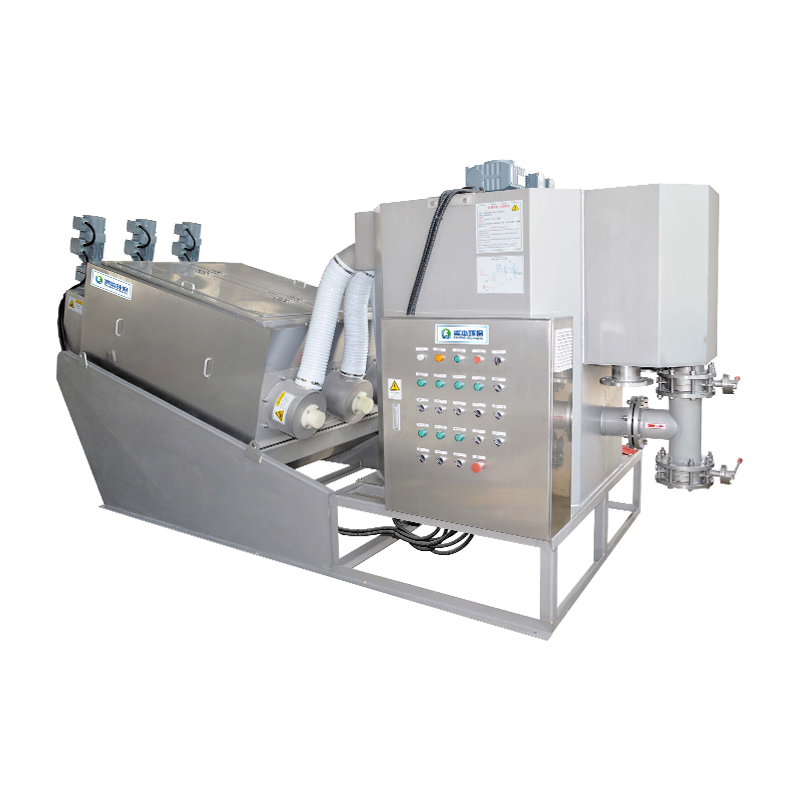
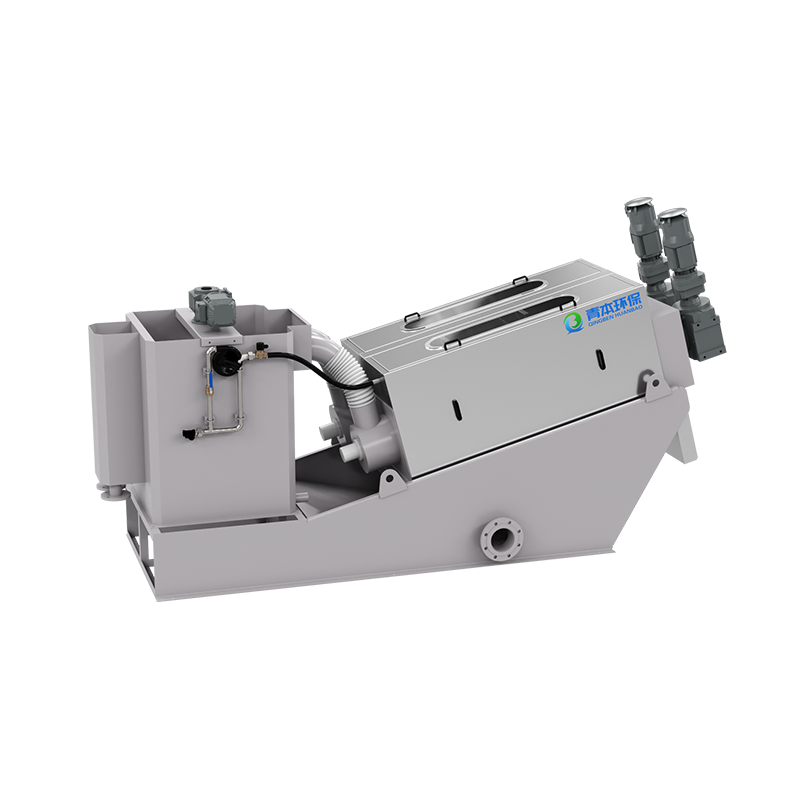
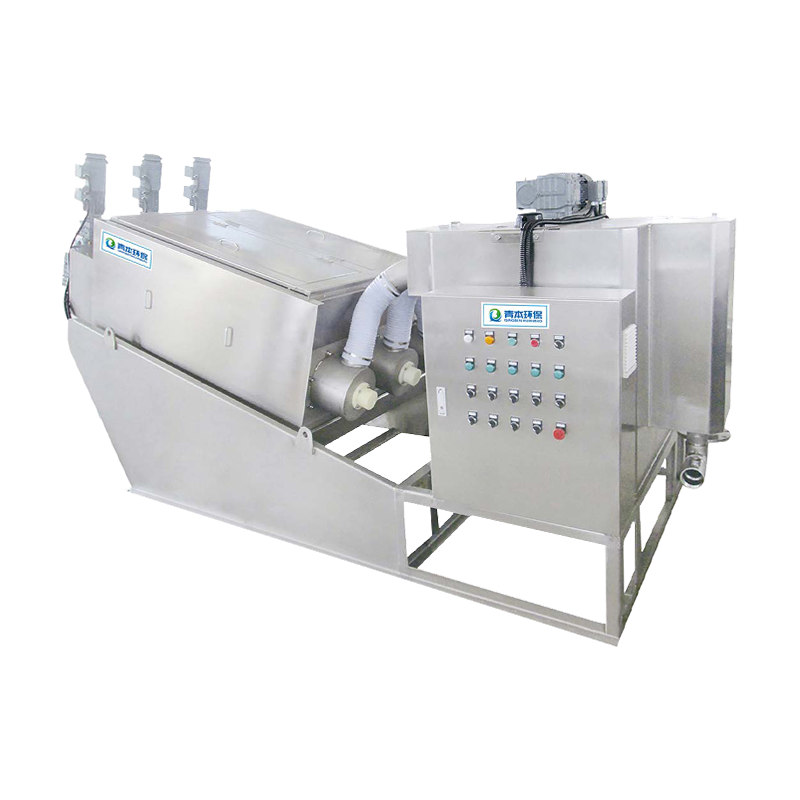
A screw press sludge dewatering machine is a continuous mechanical solid-liquid separator that uses a slowly rotating helical screw inside a cylindrical screen drum to progressively squeeze water out of sludge. Unlike belt filter presses or centrifuges, the screw press operates at very low rotational speeds — typically 2 to 5 RPM — which dramatically reduces energy consumption and mechanical wear.
The Four Stages of Screw Press Dewatering
- Conditioning: Polymer flocculant is dosed into the incoming sludge stream, binding fine particles into larger flocs that release water more readily under mechanical pressure.
- Gravity drainage zone: Flocculated sludge enters the inlet end of the screen drum, where free water drains through the filter gaps by gravity alone before any mechanical pressure is applied.
- Pressure zone: As the screw conveys sludge toward the discharge end, the pitch of the screw flights decreases and the drum diameter narrows, progressively compressing the sludge cake and expelling bound water through the screen.
- Cake discharge: The dewatered cake exits through an adjustable back-pressure plate, which controls cake dryness. The filtrate (separated water) is collected and returned to the treatment process.
The entire process is continuous and largely self-cleaning — the rotating screw prevents screen blinding, which is a common failure mode in static filter systems. This is why screw press dewatering is well-suited to unattended or lightly supervised operation.
Screw Press vs. Other Solid-Liquid Separator Technologies: Performance Comparison
Choosing the right solid-liquid separator technology depends on sludge type, target cake dryness, energy budget, and operating environment. The table below compares screw press dewatering against the three most commonly specified alternatives across critical performance dimensions.
| Performance Metric | Screw Press | Belt Filter Press | Centrifuge | Chamber Filter Press |
|---|---|---|---|---|
| Cake moisture content | 75–82% | 78–85% | 76–82% | 55–70% |
| Volume reduction (typical) | 50–60% | 45–55% | 48–58% | 60–75% |
| Energy consumption (kWh/tonne DS) | 15–30 | 20–40 | 60–120 | 25–50 |
| Noise level | Low (55–65 dB) | Moderate | High (80–90 dB) | Low |
| Continuous operation | Yes | Yes | Yes | Batch only |
| Screen/media wash water required | Minimal | High (belt washing) | None | Moderate |
| Suitability for fibrous sludge | Excellent | Good | Poor | Good |
Energy Consumption by Dewatering Technology (kWh per tonne of dry solids, midpoint values)
Screw Press
Belt Filter Press
Chamber Filter Press
Centrifuge
Screw press dewatering consistently delivers the lowest energy cost per tonne of dry solids processed.
Key Factors That Determine Whether You Achieve 60% Volume Reduction
The 60% volume reduction benchmark is achievable, but it is not automatic. Several variables directly control the outcome, and understanding them allows operators to tune performance proactively rather than accept suboptimal results.
Polymer Conditioning: The Single Biggest Lever
Polymer flocculant dose and type account for 30% to 40% of final cake dryness variation across comparable installations. Under-dosing leaves fine particles unbound, increasing filtrate turbidity and raising cake moisture. Over-dosing wastes chemical and can reduce dewatering by creating an overly viscous floc structure. Optimal polymer dose for municipal activated sludge typically falls between 4 and 8 kg active polymer per tonne of dry solids, but this must be determined by jar testing for each specific sludge.
Screw Speed and Back-Pressure Plate Setting
Screw rotational speed controls residence time in the pressure zone. Slower speeds increase dwell time and generally produce drier cake — but also reduce throughput. The back-pressure plate at the discharge end provides the counterforce against which the screw compresses the cake. Increasing back pressure by one adjustment increment typically reduces cake moisture by 1 to 3 percentage points, at the cost of slightly higher motor torque. Operators should treat screw speed and back pressure as paired variables and optimize them together.
Sludge Feed Concentration
Feed sludge entering a screw press sludge dewatering machine should ideally have a total solids (TS) content between 0.5% and 4%. Too dilute, and the machine must process excessive volumes of water before reaching the pressure zone, reducing effective throughput. Too concentrated, and the flocculation step becomes inconsistent. Pre-thickening using a gravity thickener or dissolved air flotation (DAF) unit is recommended when feed TS is consistently below 0.8%.
Sludge Type and Biological Activity
Different sludge types have inherently different dewaterability. The table below shows typical cake dryness ranges achievable with screw press dewatering for common sludge types:
| Sludge Type | Typical Feed TS (%) | Cake Moisture After Screw Press | Volume Reduction |
|---|---|---|---|
| Municipal activated sludge (WAS) | 0.8–1.5% | 78–83% | 50–58% |
| Anaerobically digested sludge | 2–4% | 75–80% | 55–62% |
| Food processing wastewater sludge | 1–3% | 74–79% | 56–63% |
| Paper mill fiber sludge | 2–5% | 70–77% | 58–65% |
| Livestock manure slurry | 3–6% | 72–78% | 57–65% |
Operational Benefits Beyond Volume Reduction
Screw press dewatering delivers measurable operational benefits that extend well beyond the headline volume reduction figure. Facilities transitioning from older solid-liquid separator technologies consistently report improvements across multiple cost centers.
- Labor reduction: The self-cleaning screw mechanism eliminates the daily belt washing and media inspection routines associated with belt presses — operators report saving 1 to 2 hours of manual labor per shift per machine.
- Transport cost savings: A 60% volume reduction directly cuts sludge disposal transport trips by a corresponding margin. For a plant disposing of sludge by road tanker, this typically means 3 to 4 fewer trips per week for a 10 tonne/day installation.
- Odor control: The enclosed drum design of screw press sludge dewatering machines significantly reduces airborne odor release compared to open belt presses — a notable benefit for plants located near residential areas.
- Low wash water demand: Screw press systems typically require only 0.5 to 1.5 m3 of wash water per hour, compared to 10 to 20 m3/hour for comparable belt filter press installations.
- Automated control compatibility: Modern screw press systems integrate with SCADA and PLC control platforms, allowing remote monitoring of torque, throughput, and cake dryness — enabling data-driven optimization without on-site presence.
Cumulative Operational Cost Savings: Screw Press vs. Belt Filter Press (Indexed, Year 1 = 0)
Screw press dewatering delivers steeper cumulative savings due to lower energy, labor, and wash water costs over time.
Selecting the Right Screw Press Specification for Your Application
Screw press sludge dewatering machines are available in a range of sizes, screen gap configurations, and drive arrangements. Selecting the correct specification avoids both underperformance and unnecessary overcapacity.
Throughput Sizing
Machine throughput is rated in kilograms of dry solids per hour (kgDS/hr). To size correctly: calculate your daily dry solids load, divide by planned operating hours per day, and apply a safety factor of 1.2 to 1.3 to account for peak loads and planned maintenance windows. For example, a plant producing 500 kgDS/day running 16 hours/day requires a machine rated at minimum 38 kgDS/hr (500 ÷ 16 × 1.2).
Screen Gap Selection
Screen gap (the spacing between adjacent rings in the drum) controls the trade-off between cake dryness and filtrate clarity. Standard gap configurations include:
- 0.1–0.2 mm: Fine gap for activated sludge and thin slurries — prioritizes filtrate quality and SS capture rate
- 0.25–0.35 mm: Standard gap for mixed municipal sludge — balanced dryness and throughput
- 0.5–1.0 mm: Coarse gap for fibrous sludge (paper, food processing) — maximizes throughput with acceptable dryness
Material of Construction
For most municipal and food industry applications, 304 stainless steel screens and body components provide adequate corrosion resistance at a reasonable material cost. For high-chloride environments (marine, chemical, or certain industrial wastewaters), 316L stainless steel should be specified throughout. All wetted components should carry a material certification to avoid substitution with lower-grade alloys.
Maintenance Practices That Protect Long-Term Dewatering Performance
Screw press dewatering machines are among the lowest-maintenance solid-liquid separator technologies available, but a neglected machine will progressively lose dewatering performance. The following maintenance schedule preserves both throughput and cake dryness across the full service life of the equipment.
| Interval | Task | Purpose |
|---|---|---|
| Daily | Check filtrate clarity and cake discharge consistency | Early detection of screen blinding or polymer dosing issues |
| Weekly | Inspect screen drum for partial blockage; flush with wash water cycle | Maintains screen open area and dewatering throughput |
| Monthly | Lubricate screw shaft bearings; check drive motor amp draw | Prevents bearing wear and identifies excess torque before failure |
| Quarterly | Inspect screw flights for wear; measure screen gap at multiple points | Worn flights reduce compression; gap drift reduces cake dryness |
| Annual | Full strip-down inspection; replace polymer dosing pump diaphragms | Restores original performance specification; validates wear parts |
About Qingben Environmental Technology (Jiangsu) Co., Ltd.
Qingben Environmental Technology (Jiangsu) Co., Ltd. is a professional enterprise specializing in the manufacturing and service of sludge and wastewater treatment equipment. We are based in the field of sludge and wastewater treatment equipment research and development, and we specialize in providing sludge dewatering machines, sludge drying equipment, complete sets of wastewater treatment equipment, river and lake sediment drying equipment, and technical services.
As a professional custom screw press sludge dewatering machine manufacturer and solid-liquid separator factory, we provide comprehensive technical support from project consultation, design, and construction to operation and maintenance — ensuring the successful implementation and efficient operation of sewage treatment and sludge treatment projects. Our team works closely with clients across municipal, industrial, agricultural, and environmental remediation sectors to deliver tailored solutions that consistently achieve target dewatering performance from day one of commissioning.
Frequently Asked Questions
Q1: What moisture content can a screw press sludge dewatering machine realistically achieve?
For most municipal and industrial sludge types, a well-configured screw press achieves a cake moisture content of 75% to 82%. Anaerobically digested sludge and fibrous industrial sludge often reach the lower end of this range. Achieving moisture below 75% generally requires additional thermal drying rather than mechanical dewatering alone.
Q2: How does a screw press compare to a centrifuge as a solid-liquid separator for activated sludge?
Both technologies deliver comparable cake dryness for activated sludge. However, screw press dewatering consumes 60% to 75% less energy per tonne of dry solids than a centrifuge and operates at significantly lower noise levels. For plants where energy cost and noise are priorities, a screw press is the stronger choice. Centrifuges have an advantage in very high-throughput continuous operations where footprint is constrained.
Q3: Can screw press dewatering handle sludge with high sand or grit content?
High grit content accelerates abrasive wear on the screw flights and screen drum. For sludge with significant inorganic solids (above 20% of total solids), it is advisable to pre-screen or degrease the feed to remove coarse grit before it enters the screw press. Where this is not practical, hardened wear-resistant flight coatings should be specified at the time of manufacture.
Q4: Is polymer conditioning always required for screw press dewatering?
For most biological and mixed municipal sludge, polymer conditioning is essential to achieve target cake dryness and acceptable filtrate quality. However, some highly fibrous sludge types — such as paper mill primary sludge — can be processed with minimal or no polymer addition because the fiber structure provides sufficient natural filtration. A pilot test is recommended to determine the minimum effective polymer dose for any specific sludge.
Q5: What is the typical footprint of a screw press sludge dewatering machine?
A compact screw press designed for small to mid-sized municipal installations typically occupies a floor area of 1.5 m x 2.5 m to 2.0 m x 4.0 m, including the polymer dosing unit. This is substantially smaller than an equivalent-capacity belt press, which requires additional space for belt washing equipment and tensioning systems. The compact footprint makes screw press dewatering well-suited to retrofit projects in existing dewatering buildings with limited space.